Loading...
Hardware Platform
The Photonic Qubit
Computing with particles of light. Photons travel through fibers and waveguides, encode qubits in polarization or path, and turn measurement into entanglement. Most optical components operate at room temperature — only high-performance detectors and some sources need cryogenics. Photon loss is the enemy.
Operating TempRoomtemperature
Optical Gatefs–ps
Clock RateMHz–GHz
HOM Visibility~99.5%
SNSPD Efficiency~90–98%
NetworkingNative
* Effective clock rate is set by sources, detectors, switches, and feedforward latency; passive optical operations are far faster.
History & Origins
From Einstein's photon to measurement-based quantum computers and the largest quantum-advantage demonstrations.
The idea of using light for quantum information is almost as old as quantum mechanics itself. Einstein's 1905 explanation of the photoelectric effect introduced the photon as a particle of light, and the development of lasers in the 1960s made it possible to create and manipulate individual optical modes with extraordinary precision. By the 1980s, physicists were using photons to test Bell inequalities and demonstrate quantum cryptography.
The pivotal moment for photonic quantum computing came in 2001, when Knill, Laflamme, and Milburn proved that universal quantum computation is possible with only linear optics, single-photon sources, and photon-counting detectors[1]E. Knill, R. Laflamme & G. J. Milburn (2001). A scheme for efficient quantum computation with linear optics. Nature 409, 46–52.. Their KLM scheme showed that the lack of direct photon-photon interactions could be overcome by measurement-induced effective nonlinearities. The catch was resource overhead: the original KLM protocol required many ancilla photons and post-selection to make gates succeed.
A parallel thread began in 2001 with Raussendorf and Briegel's one-way quantum computer[5]R. Raussendorf & H. J. Briegel (2001). A one-way quantum computer. Phys. Rev. Lett. 86, 5188–5191.. Instead of applying gates in a circuit, a large entangled cluster state is prepared up front, and the computation is driven by sequential single-qubit measurements with classical feedforward. For photons, this was attractive because the difficult entangling step could be done during state preparation, leaving only measurements during the computation itself.
On the road to practical photonic gates, Hong, Ou, and Mandel's 1987 observation of two-photon interference at a beam splitter became the central diagnostic[16]C. K. Hong, Z. Y. Ou & L. Mandel (1987). Measurement of subpicosecond time intervals between two photons by interference. Phys. Rev. Lett. 59, 2044–2046.. When two indistinguishable photons arrive simultaneously at a 50/50 beam splitter, they always exit together — a purely quantum effect with no classical analogue. This Hong-Ou-Mandel (HOM) interference is the workhorse of linear-optical entanglement generation.
1905–1980s
Photons as Quantum Objects
Einstein's photon, lasers, Bell tests, and quantum cryptography lay the conceptual foundation.
1987–2001
Linear Optics Computing
HOM interference and the KLM proof that universal QC is possible without photon interactions.[1]E. Knill, R. Laflamme & G. J. Milburn (2001). A scheme for efficient quantum computation with linear optics. Nature 409, 46–52.[16]C. K. Hong, Z. Y. Ou & L. Mandel (1987). Measurement of subpicosecond time intervals between two photons by interference. Phys. Rev. Lett. 59, 2044–2046.
2020–2025
Quantum Advantage & Industry
Jiuzhang, Borealis, PsiQuantum Omega, Xanadu Aurora, and Quandela Belenos push scale.[7]H.-S. Zhong et al. (2020). Quantum computational advantage using photons. Science 370, 1460–1463.[8]L. S. Madsen et al. (2022). Quantum computational advantage with a programmable photonic processor. Nature 606, 75–81.[11]PsiQuantum (2025). A manufacturable platform for photonic quantum computing: the Omega silicon-photonics chipset. Nature (Feb 2025).
The 2010s saw two important simplifications. First, boson sampling — proposed by Aaronson and Arkhipov in 2011 — showed that even a restricted photonic device could solve a classically intractable problem[6]S. Aaronson & A. Arkhipov (2011). The computational complexity of linear optics. STOC 333–342.. In 2020, USTC's Jiuzhang demonstrated Gaussian boson sampling with 76 detected photons, followed by Jiuzhang 3.0 (255 photons, 2023) and Jiuzhang 4.0 (3,050 photons, 2025)[7]H.-S. Zhong et al. (2020). Quantum computational advantage using photons. Science 370, 1460–1463.[24]USTC / Jiuzhang Team (2025). Jiuzhang 4.0: Gaussian boson sampling with 3,050 detected photons. arXiv preprint.. These are not universal computers, but they are the largest photonic quantum-advantage demonstrations to date.
Second, fusion-based quantum computing (FBQC) emerged as a more loss-tolerant and manufacturable variant of cluster-state computing. Small entangled resource states are generated continuously and fused together by entangling measurements[10]S. Bartolucci et al. (2023). Fusion-based quantum computation. Nat. Commun. 14, 912.. PsiQuantum has built its entire architecture around FBQC and silicon photonics, manufacturing chips at GlobalFoundries and reporting in 2025 a suite of performance metrics including 99.5% HOM visibility and 99.22% fusion-gate fidelity[11]PsiQuantum (2025). A manufacturable platform for photonic quantum computing: the Omega silicon-photonics chipset. Nature (Feb 2025)..
Quantum Optics Fundamentals
Before qubits, there are modes. Photonic quantum computing is built on the quantum harmonic oscillator: photon-number states, creation and annihilation operators, and linear transformations of optical modes.
In quantum optics, each mode of the electromagnetic field is a quantum harmonic oscillator. The basis states of a single mode are the Fock states (or number states) , where is the number of photons in that mode. The state is the vacuum — no photons in the mode[2]P. Kok et al. (2007). Linear optical quantum computing with photonic qubits. Rev. Mod. Phys. 79, 135–174..
The annihilation operator removes one photon, and the creation operator adds one. Their action on Fock states is:
They satisfy the canonical bosonic commutation relation, the defining property of quantum harmonic oscillators:
The number operator counts photons:
Coherent States
A coherent state is an eigenstate of the annihilation operator and the closest quantum analogue to classical laser light. It is a superposition of all number states:
Coherent states have Poissonian photon statistics and equal uncertainty in the two field quadratures. They are used in some continuous-variable encodings and as weak probe fields, but they are not single-photon states[2]P. Kok et al. (2007). Linear optical quantum computing with photonic qubits. Rev. Mod. Phys. 79, 135–174..
Squeezed States
A squeezed state reduces quantum uncertainty in one quadrature of the field at the expense of increased uncertainty in the conjugate quadrature. The single-mode squeezed vacuum is generated by the squeezing operator :
The two quadrature operators are related to creation and annihilation operators by
For , a squeezed vacuum has and — one quadrature is quieter than the vacuum, the other is noisier. Squeezed light is the resource for continuous-variable quantum computing and for generating GKP qubits[13]M. V. Larsen et al. (2025). Integrated photonic source of Gottesman-Kitaev-Preskill qubits. Nature..
Passive Linear Optics
Passive linear optical elements — beam splitters, phase shifters, waveplates, and mirrors — preserve the total number of photons. Mathematically, their Hamiltonians are bilinear in the creation and annihilation operators:
This means a linear optical network implements a unitary transformation on the mode operators. The Reck decomposition shows that any unitary on optical modes can be built from a mesh of two-mode beam splitters and phase shifters[25]M. Reck, A. Zeilinger, H. J. Bernstein & P. Bertani (1994). Experimental realization of any discrete unitary operator. Phys. Rev. Lett. 73, 58–61..
For a single photon, this unitary acts as a rotation on the mode vector; for many photons, the quantum evolution is determined by how the creation operators transform. This photon-number-conserving property is why entangling two photons requires measurement — linear optics alone cannot create an effective photon-photon interaction.
Active Linear Optics
Not all linear optics conserves photon number. Squeezers are active linear optical elements whose Hamiltonians include terms like and . They are essential for continuous-variable schemes and can be used to generate single photons probabilistically. For discrete-variable LOQC, passive linear optics is usually sufficient; for CV and GKP encodings, squeezers are indispensable[2]P. Kok et al. (2007). Linear optical quantum computing with photonic qubits. Rev. Mod. Phys. 79, 135–174..
What Is a Photonic Qubit?
A photon is a flying qubit. The quantum information is encoded in orthogonal modes of the electromagnetic field — polarization, path, or arrival time.
Photons are almost ideal carriers of quantum information. They travel at the speed of light, couple weakly to their environment, and can be routed through optical fibers or on-chip waveguides. Unlike matter qubits that must be held in place, photons are flying qubits: they can move between modules, between buildings, or between cities while preserving quantum coherence[3]F. Flamini, N. Spagnolo & F. Sciarrino (2019). Photonic quantum information processing: a review. Rep. Prog. Phys. 82, 016001.[4]S. Slussarenko & G. J. Pryde (2019). Photonic quantum information processing: A concise review. Appl. Phys. Rev. 6, 041303..
The qubit is defined by choosing two orthogonal states of a single photon. The most common encodings are:
- •Polarization: — horizontal vs. vertical polarization. Easy to manipulate with waveplates in free space.
- •Path / dual-rail: — the photon occupies one of two spatial modes. Natural for integrated photonics.
- •Time-bin: — the photon arrives in an early or late time slot. Extremely robust in fiber.
- •Single-rail / Fock-state: — presence or absence of a photon in one mode. Compact, but photon loss becomes an undetectable error.
Polarization Qubits in Detail
A polarization qubit is perhaps the most intuitive. Any polarization state can be written as a superposition of horizontal and vertical:
Waveplates rotate this state on the Poincaré sphere. A half-wave plate (HWP) at a physical angle rotates the plane of linear polarization by ; equivalently, it implements a rotation about an equatorial axis oriented at on the Poincaré sphere. A quarter-wave plate (QWP) at 45° converts linear polarization into circular polarization by introducing a phase shift. A polarizing beam splitter maps the state into a path-encoded qubit for readout.
Path and Time-Bin Encodings
In the dual-rail encoding, a single photon in two waveguides represents the qubit. The logical states are created by the photon occupying one of two spatial modes:
A 50/50 beam splitter mixes the two modes and, up to local phases, implements a Hadamard gate. A phase shifter on one rail applies a rotation. The no-photon state is loss — a key advantage because it is detectable, unlike a silent bit flip. In operator form, the Pauli operators for a dual-rail qubit are:
These are number-conserving operators that act on the single-photon subspace.
Time-bin encoding sends the photon through a short or long path before superposition. Because the two paths share the same spatial mode, they experience nearly identical phase noise, making time-bin qubits exceptionally stable in fiber. They are the natural choice for quantum communication and for architectures like ORCA Computing[23]ORCA Computing (2024). PT-2 photonic quantum computer. ORCA Computing Product Announcement..
Continuous-Variable Qubits
A different approach encodes qubits in continuous variables of the electromagnetic field, such as squeezed optical modes. Xanadu uses Gottesman-Kitaev-Preskill (GKP) grid states — superpositions of squeezed states arranged in a lattice in phase space[13]M. V. Larsen et al. (2025). Integrated photonic source of Gottesman-Kitaev-Preskill qubits. Nature.. These bosonic qubits can be manipulated deterministically with squeezers, beam splitters, and homodyne detection, and they have their own intrinsic error correction against small displacement errors.
Why Encoding Choice Matters
The choice of encoding shapes the entire architecture. Polarization is convenient for free-space tabletop experiments. Path/dual-rail matches integrated photonics. Time-bin is ideal for fiber networks. Continuous-variable encodings can leverage deterministic gates but require different detectors and error-correction codes. Across all of them, the central challenge is the same: photons are easily lost, and they do not interact with each other directly.
Interactive: Polarization Qubit
Adjust the superposition angle and relative phase to explore polarization states. A real experiment would use a half-wave plate and a quarter-wave plate in combination to realize each state.
Controls the weight of |H⟩ vs |V⟩ in |ψ⟩ = cos θ |H⟩ + sin θ e^{iφ}|V⟩. (A half-wave plate rotates the linear component by 2α, where α is its physical angle.)
Relative phase φ: 0° for linear, ±90° for circular polarization. A quarter-wave plate at 45° provides φ ≈ ±90°.
≈ |+⟩ = (|H⟩ + |V⟩)/√2
Making Single Photons
A photonic quantum computer needs a reliable stream of indistinguishable single photons. The source technology defines much of the architecture.
Every photonic quantum computer starts with a source. The ideal source emits exactly one photon on demand, with perfect indistinguishability from every other photon, high efficiency, and the right wavelength for the rest of the system. No source meets all of these criteria today, so different platforms make different trade-offs[3]F. Flamini, N. Spagnolo & F. Sciarrino (2019). Photonic quantum information processing: a review. Rep. Prog. Phys. 82, 016001.[17]P. Lodahl et al. (2015). Interfacing single photons and single quantum dots with photonic nanostructures. Rev. Mod. Phys. 87, 347–400..
Spontaneous Parametric Down-Conversion (SPDC)
SPDC is the workhorse of university laboratories. A pump laser passes through a nonlinear crystal (such as BBO or PPKTP) and occasionally splits one pump photon into a pair of lower-energy photons. Detecting one photon of the pair heralds the presence of the other. Because the process is spontaneous, the emission is probabilistic: multiple pairs can be produced, or none at all.
The two-photon state from a type-II SPDC source is a two-mode squeezed vacuum. To leading order in the pump amplitude :
where means signal and idler photons. Detecting one photon heralds the other, but the multi-pair terms produce unwanted multi-photon events. The probability of heralded multi-pair emission scales as , which is why low pump power and multiplexing are essential for scaling[2]P. Kok et al. (2007). Linear optical quantum computing with photonic qubits. Rev. Mod. Phys. 79, 135–174..
A standard figure of merit for single-photon purity is the second-order correlation:
For an ideal single-photon source ; for coherent laser light ; for thermal light . Quantum-dot sources routinely reach .
Quantum Dots
Quantum dots are semiconductor nanostructures that act like artificial atoms. When excited, they emit a single photon at a time — on demand, or nearly so. By embedding the dot in a photonic cavity or waveguide, the emission can be directed into a specific optical mode with high efficiency.
Quandela's platform is built around InAs/GaAs quantum dots engineered for high brightness and indistinguishability[14]Quandela (2025). Belenos: a 12-qubit photonic quantum processor deployed at CEA TGCC. Quandela Press Release.[17]P. Lodahl et al. (2015). Interfacing single photons and single quantum dots with photonic nanostructures. Rev. Mod. Phys. 87, 347–400.. Modern quantum-dot sources can achieve single-photon purity and HOM visibility above 95%, making them competitive with the best SPDC sources while offering much higher brightness.
Color Centers
Color centers are defects in crystals that trap electrons and act as single-photon emitters. The nitrogen-vacancy (NV) center in diamond is the most famous, but silicon defects such as the T center are emerging as particularly promising for quantum networks because they combine a spin qubit with an optical interface at telecom wavelengths[19]D. B. Higginbottom et al. (2022). Optical observation of single spins in silicon. Nature 607, 266–270..
Photonic Inc. uses silicon T centers to build modules where a spin qubit is entangled with an emitted photon. That photon can then carry the entanglement to another module, enabling distributed quantum computing[15]Photonic Inc. (2024). Distributed entanglement between silicon T-center spin-photon qubit modules. Photonic Inc. Technical Update.. This blurs the line between a photonic quantum computer and a quantum network.
Squeezed Light and Continuous Variables
Xanadu takes a different approach. Instead of discrete single photons, it generates squeezed states of light. A single-mode squeezed vacuum is produced by the squeezing operator:
It reduces the variance of one field quadrature while increasing the conjugate quadrature. The two quadrature operators are:
A squeezed state has and for . Pairs of squeezed modes are combined on beam splitters to create entangled Gaussian cluster states, which can then be converted into Gottesman-Kitaev-Preskill (GKP) qubits[8]L. S. Madsen et al. (2022). Quantum computational advantage with a programmable photonic processor. Nature 606, 75–81.[13]M. V. Larsen et al. (2025). Integrated photonic source of Gottesman-Kitaev-Preskill qubits. Nature..
GKP states are superpositions of squeezed-state wavepackets arranged in a periodic grid in phase space. In the ideal infinite-squeezing limit they are simultaneous eigenstates of displacement operators such as and . Finite-squeezing GKP states consist of Gaussian peaks; small displacements that keep a peak within one unit cell are correctable. This gives GKP qubits intrinsic protection against photon loss and small phase-space errors.
Photon source comparison
SPDCHigh indistinguishability, probabilistic, mature
Quantum dotsOn-demand, bright, requires cryogenics / epitaxy
Color centersSpin-photon interface, native networking
Squeezed lightDeterministic, continuous-variable, GKP encoding
Linear Optics & Hong-Ou-Mandel Interference
Photons do not interact with each other. Quantum gates are built from beam splitters, phase shifters, and the quantum interference of indistinguishable photons.
A photonic quantum computer manipulates qubits with linear optical elements: beam splitters, phase shifters, waveplates, mirrors, and delay lines. These are passive or actively controlled components that do not create or destroy photons, only redirect and rephase them[2]P. Kok et al. (2007). Linear optical quantum computing with photonic qubits. Rev. Mod. Phys. 79, 135–174.[3]F. Flamini, N. Spagnolo & F. Sciarrino (2019). Photonic quantum information processing: a review. Rep. Prog. Phys. 82, 016001..
Quantized Modes and the Beam Splitter
In quantum optics, each electromagnetic mode is a harmonic oscillator. A single mode has photon-number (Fock) states and annihilation/creation operators and satisfying . The state is one photon in the mode; is the vacuum. A beam splitter couples two such modes linearly while conserving photon number[2]P. Kok et al. (2007). Linear optical quantum computing with photonic qubits. Rev. Mod. Phys. 79, 135–174.[3]F. Flamini, N. Spagnolo & F. Sciarrino (2019). Photonic quantum information processing: a review. Rep. Prog. Phys. 82, 016001..
A lossless beam splitter is described by a 2×2 unitary mixing the annihilation operators:
A common symmetric convention for a 50/50 beam splitter is:
This differs from the Hadamard matrix by local phases. A true Hadamard gate on a path-encoded qubit can be realized with this beam splitter plus phase shifters on the input or output modes. For a dual-rail qubit, a single photon entering the top port becomes — a superposition, up to a relative phase that can be corrected.
A phase shifter applies a mode-dependent phase:
Together, beam splitters and phase shifters generate the group of unitary mode transformations. Reck decomposition proves that any unitary can be implemented with a triangular mesh of two-mode beam splitters and phase shifters[2]P. Kok et al. (2007). Linear optical quantum computing with photonic qubits. Rev. Mod. Phys. 79, 135–174..
From Two Modes to N-Mode Interferometers
Beam splitters and phase shifters are not limited to two modes. An N-port interferometer applies a unitary to optical modes. Reck et al. proved that any such unitary can be decomposed into a triangular mesh of at most two-mode beam splitters and phase shifters[25]M. Reck, A. Zeilinger, H. J. Bernstein & P. Bertani (1994). Experimental realization of any discrete unitary operator. Phys. Rev. Lett. 73, 58–61..
This decomposition is the optical analogue of a QR factorization: it shows that arbitrary linear optical circuits can be built from just two primitive components. Silicon-photonics chips exploit this fact to implement thousands of tunable beam splitters and phase shifters on a single die, forming the programmable interferometers used in boson sampling and photonic processors.
Hong-Ou-Mandel Interference
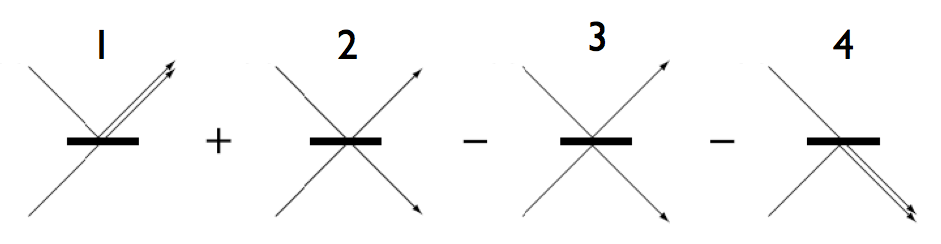
The central quantum effect in linear optics is Hong-Ou-Mandel (HOM) interference. When two indistinguishable photons enter a 50/50 beam splitter, one in each port, they always exit in the same output port. The quantum amplitudes for both photons transmitting and both reflecting cancel destructively, leaving no coincidences[16]C. K. Hong, Z. Y. Ou & L. Mandel (1987). Measurement of subpicosecond time intervals between two photons by interference. Phys. Rev. Lett. 59, 2044–2046..
This is easiest to see in the Fock-state picture. For the symmetric 50/50 beam splitter, the input transforms as:
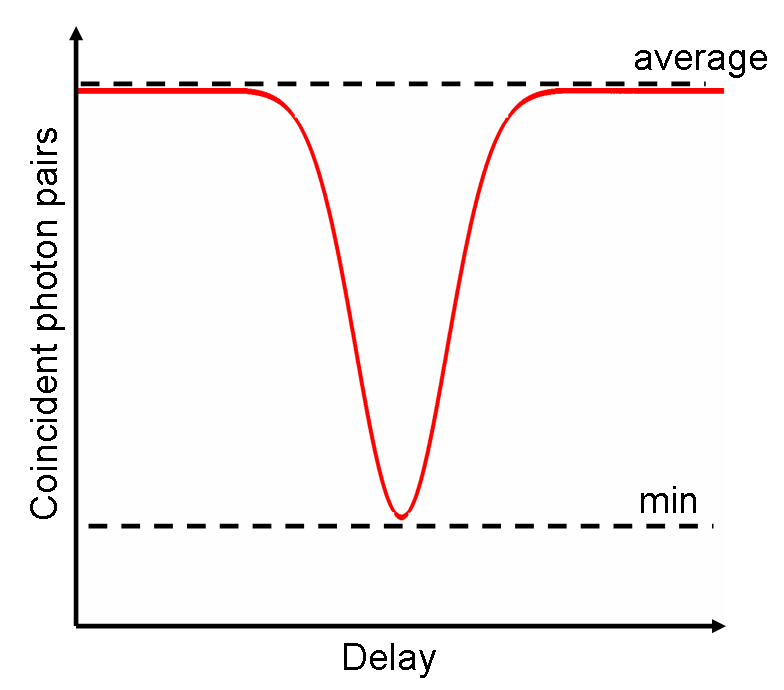
The output amplitude is zero because the two paths to it interfere destructively. If the photons are distinguishable — for example, because they arrive at different times or have different colors — the interference disappears and coincidences reappear. Partial distinguishability fills in the dip proportionally.
For a beam splitter with arbitrary reflectivity and transmissivity , the two-photon output probabilities are:
At , : perfect bunching. At or , the photons follow their own paths without interference.
The HOM visibility quantifies indistinguishability:
where is the coincidence rate at zero delay and is the rate for fully distinguishable photons. Imperfections such as timing jitter, spectral mismatch, or polarization rotation reduce . State-of-the-art sources and interferometers reach ; PsiQuantum reported 99.5% HOM visibility on its Omega platform[11]PsiQuantum (2025). A manufacturable platform for photonic quantum computing: the Omega silicon-photonics chipset. Nature (Feb 2025)..
Why Photons Do Not Interact — and Why That Is Okay
In empty space, two photons pass through each other unchanged. There is no direct photon-photon interaction to create a two-qubit gate. This seems fatal for quantum computing, but the KLM scheme showed it is not: by measuring ancillary photons and using feedforward, effective nonlinearities can be induced[1]E. Knill, R. Laflamme & G. J. Milburn (2001). A scheme for efficient quantum computation with linear optics. Nature 409, 46–52..
The basic idea is that measurement projects the remaining photons into an entangled state. The price is that the measurement outcomes are probabilistic, so the gate succeeds only some of the time. With enough ancilla photons and rapid feedforward, these probabilistic gates can be made effectively deterministic. Cluster-state and fusion-based architectures reduce this overhead dramatically by moving most of the entanglement generation offline.
From KLM to Cluster States & Fusion
Without direct photon-photon interactions, entanglement is generated through measurement. KLM, cluster-state MBQC, and fusion-based QC are the main architectures.
A universal quantum computer needs single-qubit rotations and at least one entangling two-qubit gate. For photons, single-qubit gates are easy: waveplates, beam splitters, and phase shifters implement arbitrary rotations. The hard part is the two-qubit gate.
The KLM Scheme
In 2001, Knill, Laflamme, and Milburn showed that linear optics plus measurement is sufficient for universal quantum computation[1]E. Knill, R. Laflamme & G. J. Milburn (2001). A scheme for efficient quantum computation with linear optics. Nature 409, 46–52.. The basic building block is a probabilistic controlled-sign (CZ) gate implemented with beam splitters and photon detectors. Two photonic qubits enter an optical network; ancilla photons are measured, and the measurement outcome heralds whether the gate succeeded.
A simple path-encoded CZ gate works as follows. Each qubit is a dual-rail photon. A nonlinear sign (NS) gate applies a conditional phase shift of only when two photons occupy the same mode. The NS gate is built from beam splitters and detectors; it succeeds with probability in its simplest form. The full CZ gate then combines two NS gates and beam splitters to apply:
Because the gate is heralded but not deterministic, the KLM scheme uses quantum teleportation with ancilla Bell states to boost the success probability arbitrarily close to one. The original construction was conceptually important but resource-intensive, motivating cluster-state and fusion-based architectures.
The nonlinear sign (NS) gate is the elementary nonlinear operation in KLM. It acts on the lowest three Fock states of a single mode: , , and . A simple three-port NS gate uses two beam splitters and one ancilla photon; it succeeds with probability [1]E. Knill, R. Laflamme & G. J. Milburn (2001). A scheme for efficient quantum computation with linear optics. Nature 409, 46–52..
A CZ gate for two dual-rail qubits is built by combining two NS gates with additional beam splitters. The NS gate injects the conditional phase that linear optics cannot produce directly. Higher-success-probability gates are obtained by teleporting the NS operation into the circuit using entangled ancilla states[1]E. Knill, R. Laflamme & G. J. Milburn (2001). A scheme for efficient quantum computation with linear optics. Nature 409, 46–52..
Parity Gates and CNOT
Parity gates are a simpler way to build entangling gates. A parity gate measures whether two photonic qubits have the same parity (even or odd number of photons in a particular mode) without revealing the individual qubit values. The measurement outcome heralds an entangling operation[2]P. Kok et al. (2007). Linear optical quantum computing with photonic qubits. Rev. Mod. Phys. 79, 135–174..
Two parity gates in complementary bases — one in the computational basis, one in the diagonal basis — are sufficient to implement a controlled-NOT (CNOT) gate. This was demonstrated experimentally by O'Brien et al. and Pittman et al. shortly after the KLM proposal[26]J. L. O'Brien et al. (2003). Demonstration of an all-optical quantum controlled-NOT gate. Nature 426, 264–267.[27]T. B. Pittman et al. (2003). Experimental controlled-NOT logic gate for single photons in the coincidence basis. Phys. Rev. A 68, 032316..
Parity gates are easier to implement than full NS gates because they only require distinguishing even from odd photon number, and they are the building blocks of cluster-state and fusion-based architectures.
Measurement-Based Quantum Computing (MBQC)
In MBQC, the computation begins by preparing a large entangled state called a cluster state. For qubits arranged on a graph , the cluster state is defined by:
where and applies a controlled- between neighboring qubits. The state is uniquely characterized by stabilizers with eigenvalue for every vertex [5]R. Raussendorf & H. J. Briegel (2001). A one-way quantum computer. Phys. Rev. Lett. 86, 5188–5191..
Once the cluster is ready, the rest of the computation consists only of single-qubit measurements, with each measurement basis conditioned on previous outcomes. The entanglement is consumed measurement by measurement, driving the computation forward.
For photons, this is powerful because the difficult entangling step is done during state preparation. The cluster can be built from small entangled units — such as polarization-entangled photon pairs — fused together by Bell-state measurements. After preparation, only detectors and fast feedforward are needed.
The downside is that cluster states are fragile. Photon loss anywhere in the cluster corrupts the computation, so the cluster must be generated, measured, and corrected with very low loss. This has driven interest in more modular and loss-tolerant variants.
Fusion-Based Quantum Computing (FBQC)
FBQC is a modular form of MBQC. Instead of building one giant cluster state, small entangled resource states are generated continuously and then fused together by entangling measurements[10]S. Bartolucci et al. (2023). Fusion-based quantum computation. Nat. Commun. 14, 912.. The resource states are typically small graph states with 3–6 photons, which can be produced deterministically or with modest multiplexing.
A fusion measurement is a projective measurement that entangles two resource states. The simplest is type-I fusion: measuring one photon from each of two three-photon resource states in the basis. When the outcome is , the remaining photons inherit the entanglement of a larger graph state; the outcome applies a known local correction.
Type-II fusion measures two photons in the Bell basis. It fuses two graph states while preserving more connectivity. In both cases, photon loss is detected as a missing measurement outcome and treated as an erasure by the decoder. PsiQuantum reports fusion-gate fidelities of 99.22% on its Omega platform[11]PsiQuantum (2025). A manufacturable platform for photonic quantum computing: the Omega silicon-photonics chipset. Nature (Feb 2025)..
PsiQuantum's architecture is built on FBQC because it is more compatible with silicon-photonics manufacturing. Small resource states can be generated in identical units across a chip, and fusions are performed by interferometers and detectors.
Boson Sampling
Boson sampling is a restricted photonic model that is not universal for quantum computing but is believed to be classically hard[6]S. Aaronson & A. Arkhipov (2011). The computational complexity of linear optics. STOC 333–342.. Photons are injected into a large passive linear interferometer and detected at the outputs. The probability distribution over output patterns is related to the permanent of a matrix, a quantity that is computationally difficult to compute exactly.
In 2020, USTC's Jiuzhang demonstrated Gaussian boson sampling with 76 detected photons, claiming a quantum advantage[7]H.-S. Zhong et al. (2020). Quantum computational advantage using photons. Science 370, 1460–1463.. Jiuzhang 3.0 reached 255 photons in 2023, and Jiuzhang 4.0 reported 3,050 detected photons across 8,176 modes in 2025[24]USTC / Jiuzhang Team (2025). Jiuzhang 4.0: Gaussian boson sampling with 3,050 detected photons. arXiv preprint.. These experiments push photon-source brightness, interferometer scale, and detector performance, even though they do not run arbitrary algorithms.
KLM
First proof that linear optics + measurement is universal, but high overhead.
MBQC
Prepare a cluster state, then compute by single-qubit measurements with feedforward.
FBQC
Fuse small resource states continuously; more modular and loss-tolerant.
Chips, Detectors & Feedforward
Modern photonic quantum computing moves light onto integrated chips and detects single photons with cryogenic superconducting sensors.
Early photonic experiments used bulk optics on optical tables: free-space beam splitters, mirrors, and motorized stages. Today, the field is moving toward integrated photonic chips that pack thousands of optical components onto a semiconductor die[9]J. Wang et al. (2020). Integrated photonic quantum technologies. Nat. Photonics 14, 273–284.. This shift is essential for scaling and for leveraging the manufacturing infrastructure of the semiconductor industry.
Integrated Photonic Platforms
The two leading material platforms are:
- •Silicon photonics (Si/SOI): compatible with CMOS foundries, supports compact modulators and detectors, and integrates with electronics. Used by PsiQuantum.
- •Silicon nitride (SiN): ultra-low propagation loss and a wide transparency window. Best research waveguides reach ~0.03 dB/m loss, though commercial SiN is higher.
A typical photonic chip contains beam splitters, phase shifters (thermo-optic or electro-optic), wavelength filters, and fiber couplers. The loss budget is ruthless: even 0.1 dB per component adds up across thousands of elements. PsiQuantum's Omega platform demonstrated chip-to-chip interconnect fidelity of 99.72%, showing that very low-loss integration is possible[11]PsiQuantum (2025). A manufacturable platform for photonic quantum computing: the Omega silicon-photonics chipset. Nature (Feb 2025)..
Single-Photon Detectors
Detecting single photons is harder than generating them. The leading technology is the superconducting nanowire single-photon detector (SNSPD), which operates at 1–4 K. A photon absorbed in a thin superconducting nanowire creates a resistive hotspot, producing a measurable voltage pulse.
Real detectors are not perfect. With quantum efficiency , an -photon Fock state produces clicks with binomial probability. The detector positive operator-valued measure (POVM) element for observing clicks is:
For this reduces to the projector . For , photon loss makes a single-photon state produce no click with probability — the dominant error in most photonic systems.
SNSPDs offer:
- •High efficiency: system detection efficiency >90–98% at telecom wavelengths.
- •Low timing jitter: sub-10 ps jitter, enabling precise time-bin measurements.
- •Low dark counts: sub-Hz false detection rates.
The cryogenic requirement of SNSPDs is the main exception to photonics' room-temperature promise. Room-temperature avalanche photodiodes (SPADs) exist but have much lower efficiency (~10–30%) and higher dark counts, limiting their use in fault-tolerant architectures.
Photon-Number-Resolving Detectors
Many photonic protocols need to distinguish 0, 1, 2, … photons. Photon-number-resolving (PNR) detectors can be built from arrays of SNSPDs, transition-edge sensors, or superconducting nanowire arrays. A PNR detector with finite efficiency still obeys the binomial POVM above, but now the classical post-processing resolves from the number of firing elements. PNR detection is essential for continuous-variable schemes and for some fusion-based protocols.
Feedforward and Delay Lines
Measurement-based photonic computing requires fast feedforward: the outcome of one measurement must determine the basis of a later measurement within the photon's coherence time. This is typically implemented with fiber delay lines or on-chip delay waveguides that store photons while electronics process the detector signals and configure switches.
The effective clock rate of a photonic quantum computer is therefore set not by the speed of light but by the source repetition rate, detector reset time, switch latency, and the length of the delay lines. Current systems operate at MHz to GHz effective rates, with push toward faster electro-optic switches and shorter feedback loops.
Key photonic hardware parameters
Waveguide loss (SiN)
~0.1–2 dB/m
SNSPD efficiency
90–98%
SNSPD temperature
1–4 K
HOM visibility
~95–99.5%
Quantum Error Correction for Photons
Photon loss is the dominant error. Photonics turns that weakness into an advantage by treating loss as a detectable erasure, then correcting it with loss-tolerant codes.
In most quantum computing platforms, the biggest errors are bit flips, phase flips, and decoherence. In photonics, the biggest error is simpler and more punishing: the photon disappears. Every beam splitter, waveguide bend, fiber splice, and detector loses a small fraction of photons. Over a large computation, these losses compound exponentially.
Fortunately, many photonic encodings turn photon loss into an erasure error: when a photon is lost, the detector registers no count, so the location of the error is known. Erasure errors are fundamentally easier to correct than undetected bit flips or phase flips because the decoder already knows where to look[4]S. Slussarenko & G. J. Pryde (2019). Photonic quantum information processing: A concise review. Appl. Phys. Rev. 6, 041303.[21]J. E. Bourassa et al. (2021). Blueprint for a scalable photonic fault-tolerant quantum computer. Quantum 5, 392..
Loss as Erasure
In a dual-rail or time-bin encoding, the no-photon state is distinct from the logical and states. If a detector fails to see a photon when one was expected, the qubit is flagged as erased. The threshold for erasure correction is higher than for depolarizing noise, and the overhead to reach a target logical error rate is lower.
Photon loss is modeled by an attenuation channel. A photon in a single mode is transmitted with probability and lost to the environment with probability . The Kraus operators are:
acting on the input density matrix as . For a single-photon input, this reduces to .
In a dual-rail qubit , loss of either photon maps the state to , which is outside the logical subspace. This makes loss a detectable erasure. Erasure thresholds for practical photonic fault-tolerant schemes are typically from a few percent up to roughly 10%, while ideal erasure-only or Varnava–Browne–Rudolph tree-code analyses can reach ~50% — all far above typical depolarizing thresholds (~1%). Below threshold, the logical error rate scales approximately as:
where is the erasure threshold and is the code distance. For small , the logical error rate is suppressed exponentially with code distance.
Loss-Tolerant Codes
Photonic quantum computing has inspired a family of codes designed specifically for loss. The surface-GKP code combines Gottesman-Kitaev-Preskill bosonic encoding with a surface-code shell to correct both small displacement errors and photon loss[13]M. V. Larsen et al. (2025). Integrated photonic source of Gottesman-Kitaev-Preskill qubits. Nature.[21]J. E. Bourassa et al. (2021). Blueprint for a scalable photonic fault-tolerant quantum computer. Quantum 5, 392.. Xanadu's architecture uses this approach.
For discrete-variable photonics, topological cluster states and foliated codes protect against loss and gate errors simultaneously. In FBQC, the resource states are small graph states, and the fusion network itself forms a topological code. Failed fusions create erasure-like syndromes that the decoder can handle. PsiQuantum has argued that its architecture can tolerate a few percent loss per photon, making fault tolerance feasible within silicon-photonics manufacturing[11]PsiQuantum (2025). A manufacturable platform for photonic quantum computing: the Omega silicon-photonics chipset. Nature (Feb 2025)..
The Overhead Challenge
Photonic fault tolerance is not yet demonstrated. While physical components have reached impressive performance — 99%+ HOM visibility, 99%+ fusion fidelity, 90–98% detector efficiency — combining these into a logical qubit with a lower error rate than any physical component remains the next milestone.
The overhead is architecture-dependent. Some discrete-variable photonics roadmaps aim for modest physical-to-logical ratios by leveraging erasure conversion and small resource states[14]Quandela (2025). Belenos: a 12-qubit photonic quantum processor deployed at CEA TGCC. Quandela Press Release.. At the other extreme, all-photonic surface-code schemes may require millions of physical photons per logical qubit. The field is actively exploring the trade-off between component count, loss tolerance, and gate speed, and a below-threshold photonic logical qubit remains the next critical milestone.
Erasure advantage
Lost photons are detected, so the decoder knows where errors occurred.
Open milestone
A below-threshold photonic logical qubit has not yet been demonstrated.
Videos & Talks
Curated videos that explain photonic quantum computing from first principles to industrial roadmaps.
Photonic Quantum Computing and Applications
~60 minA colloquium by Saikat Guha covering the principles of photonic quantum computing and its real-world applications.
Quantum Computing with Light: The Breakthrough?
~20 minAn accessible explainer on why light-based quantum computing is promising and what the current breakthroughs mean.
Xanadu Demonstrates World's First Error-Resistant Photonic Qubit
~10 minA demonstration of error-resistant photonic qubits and the road toward fault-tolerant photonic quantum computing.
The Genius of Computing with Light
~20 minA deep dive into how photons can be used to process quantum information and the engineering challenges involved.
Who Is Building It
Photonic quantum computing attracts both dedicated startups and large-scale industrial bets.
PsiQuantum
Omega chipset: 99.5% HOM visibility, 99.22% fusion-gate fidelity (2025)
Silicon-photonics fusion-based QC, GlobalFoundries manufacturing, utility-scale targets
Xanadu
Aurora: 12-qubit modular networked photonic computer; on-chip GKP states (2025)
Continuous-variable photonics, squeezed-light GKP qubits, PennyLane software stack
Quandela
Lucy (MOSAIQ-12): 12-qubit system deployed at CEA TGCC (2025)
Quantum-dot single-photon sources, discrete-variable photonic qubits
Photonic Inc.
Distributed entanglement between silicon T-center modules (2024)
Spin-photon interfaces, distributed quantum computing, Microsoft partnership
ORCA Computing
PT-2: ~4,000× boost over PT-1 (2024)
Time-bin encoded photonic qumodes, photonic memory architecture
USTC / Jiuzhang
Jiuzhang 4.0: 3,050 detected photons, 8,176 modes (2025)
Gaussian boson sampling, largest photonic quantum-advantage demonstrations
Strengths
- •Room-temperature operation for most optical components; only detectors and some sources need cryogenics
- •Extremely fast passive optical gates (femtosecond–picosecond timescales)
- •Native networking: photons are the natural carrier for quantum communication and distributed computing
- •Weak coupling to local noise (phonons, charge noise, magnetic fluctuations) enables long coherence in flight
- •CMOS-compatible manufacturing: silicon photonics and silicon nitride leverage existing semiconductor fabs
Limitations
- •Photon loss is the central error mechanism: every component, splice, bend, and detector loses photons
- •No deterministic photon-photon interaction: entangling gates require measurement, multiplexing, and feedforward
- •Probabilistic entangling operations create overhead; fault-tolerant logical qubits have not yet been demonstrated
- •High-performance detectors (SNSPDs) require cryogenic cooling; room-temperature SPADs are much less efficient
- •Scaling requires managing billions of optical components with tight loss budgets and phase stability
References
Key papers and reviews for further reading on photonic quantum computing.
[1]
E. Knill, R. Laflamme & G. J. Milburn, A scheme for efficient quantum computation with linear optics, Nature 409, 46–52 (2001).
[2]
P. Kok et al., Linear optical quantum computing with photonic qubits, Rev. Mod. Phys. 79, 135–174 (2007).
[3]
F. Flamini, N. Spagnolo & F. Sciarrino, Photonic quantum information processing: a review, Rep. Prog. Phys. 82, 016001 (2019).
[4]
S. Slussarenko & G. J. Pryde, Photonic quantum information processing: A concise review, Appl. Phys. Rev. 6, 041303 (2019).
[5]
R. Raussendorf & H. J. Briegel, A one-way quantum computer, Phys. Rev. Lett. 86, 5188–5191 (2001).
[6]
S. Aaronson & A. Arkhipov, The computational complexity of linear optics, STOC 333–342 (2011).
[7]
H.-S. Zhong et al., Quantum computational advantage using photons, Science 370, 1460–1463 (2020).
[8]
L. S. Madsen et al., Quantum computational advantage with a programmable photonic processor, Nature 606, 75–81 (2022).
[9]
J. Wang et al., Integrated photonic quantum technologies, Nat. Photonics 14, 273–284 (2020).
[10]
S. Bartolucci et al., Fusion-based quantum computation, Nat. Commun. 14, 912 (2023).
[11]
PsiQuantum, A manufacturable platform for photonic quantum computing: the Omega silicon-photonics chipset, Nature (Feb 2025) (2025).
[12]
Xanadu, Aurora: a 12-qubit modular, networked photonic quantum computer, Xanadu Technical Blog (2025).
[13]
M. V. Larsen et al., Integrated photonic source of Gottesman-Kitaev-Preskill qubits, Nature (2025).
[14]
Quandela, Belenos: a 12-qubit photonic quantum processor deployed at CEA TGCC, Quandela Press Release (2025).
[15]
Photonic Inc., Distributed entanglement between silicon T-center spin-photon qubit modules, Photonic Inc. Technical Update (2024).
[16]
C. K. Hong, Z. Y. Ou & L. Mandel, Measurement of subpicosecond time intervals between two photons by interference, Phys. Rev. Lett. 59, 2044–2046 (1987).
[17]
P. Lodahl et al., Interfacing single photons and single quantum dots with photonic nanostructures, Rev. Mod. Phys. 87, 347–400 (2015).
[19]
D. B. Higginbottom et al., Optical observation of single spins in silicon, Nature 607, 266–270 (2022).
[21]
J. E. Bourassa et al., Blueprint for a scalable photonic fault-tolerant quantum computer, Quantum 5, 392 (2021).
[23]
ORCA Computing, PT-2 photonic quantum computer, ORCA Computing Product Announcement (2024).
[24]
USTC / Jiuzhang Team, Jiuzhang 4.0: Gaussian boson sampling with 3,050 detected photons, arXiv preprint (2025).
[25]
M. Reck, A. Zeilinger, H. J. Bernstein & P. Bertani, Experimental realization of any discrete unitary operator, Phys. Rev. Lett. 73, 58–61 (1994).
[26]
J. L. O'Brien et al., Demonstration of an all-optical quantum controlled-NOT gate, Nature 426, 264–267 (2003).
[27]
T. B. Pittman et al., Experimental controlled-NOT logic gate for single photons in the coincidence basis, Phys. Rev. A 68, 032316 (2003).
Want to see how it compares?
Each hardware platform makes different tradeoffs. See how photonic qubits stack up against superconducting qubits, trapped ions, and neutral atoms.
Browse All Platforms